BODY TYPE REFERENCE
What do Wave · Straight · Natural mean?
These three labels approximate styling-oriented frame categories commonly used in Korea from measurable body proportions. They are not medical classifications or absolute diagnoses, and one person may show traits associated with more than one type. The current numerical boundaries are prototype heuristic calibration values, not validated anthropometric W/S/N standards.
Back to top ↑
Commonly described traits
- The upper body tends to look relatively slim and soft
- The torso from underbust to pelvis may appear relatively long
- The pelvis, hips and thighs may have more visual presence than the upper body
- Waist definition and lower-body curves may appear more noticeable
- The visual center of mass is often perceived lower on the body
What raises the Wave score on this site
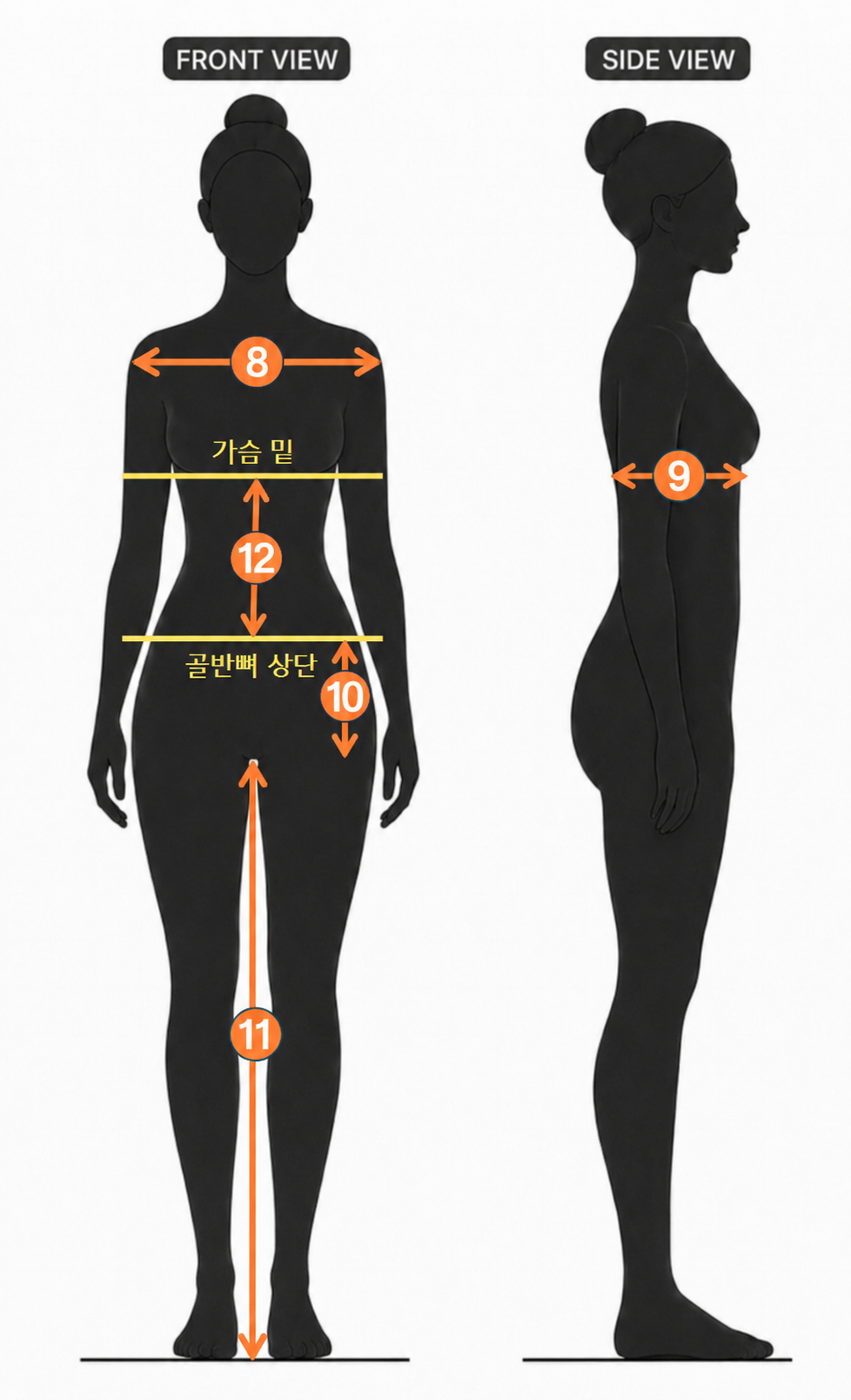
- Torso AP depth ÷ shoulder widthwhen it is below the reference
- Underbust-to-iliac-crest length ÷ heightwhen it is longer
- Hip circumference − waist circumferencewhen the difference is relatively larger
- when iliac-crest breadth is relatively wide compared with the shoulders
- when pelvic position is relatively lower and the vertical pelvic segment is longer
Commonly described traits
- The upper body may look firm with more front-to-back volume
- The torso tends to have more central depth rather than looking thin and flat
- The underbust-to-pelvis segment may appear relatively short
- Hip and thigh volume may appear to sit relatively high
- The upper body may carry relatively stronger visual weight
What raises the Straight score on this site
- Torso AP depth ÷ shoulder widthwhen it is above the reference
- Underbust-to-iliac-crest length ÷ heightwhen it is shorter
- when the top of the iliac crest sits relatively high for height
- when the hip-to-waist difference is smaller than the Wave tendency
- when pelvic length and thigh volume are not strongly lower-body dominant
Commonly described traits
- Bone structure and frame may stand out more than soft-tissue curves
- The shoulder frame may look broad or relatively straight
- Collarbones, wrists, knees and other joints are often described as visually prominent
- The overall frame may read as long and open rather than upper- or lower-body dominant
- This is treated more like a separate skeletal-frame axis from Wave/Straight
What raises the Natural score on this site
- Shoulder width ÷ heightwhen above the reference — highest weight
- Iliac-crest width ÷ heightwhen above the reference — secondary frame signal
- A wide iliac crest alone does not immediately classify the frame as Natural if the shoulder frame is small
- Because wrist and knee size are not entered, the Natural estimate is more limited than the other two types
How the current classifier is structured
Natural frameThe frame score is estimated first using roughly 75% shoulder/height and 25% iliac-crest/height.
Wave ↔ StraightTorso depth ratio receives the largest weight, then torso length, hip-waist difference, pelvic height, pelvic length and thigh ratio are combined.
BMIWeight itself does not determine a type. When BMI is far from the central reference range, only soft-tissue-sensitive signals are mildly damped.
Mixed tendencyIf the top two scores are close, the result is shown as a mixed tendency instead of forcing a single type.
BWH SILHOUETTE REFERENCE
Silhouette body shape from bust · waist · hip ratios
Separate from the frame-type result, this classification compares bust, waist and hip circumferences to describe clothing silhouette and fit. CalculatorLib, one of the public references, also asks for upper-hip circumference; because that measurement is not part of this model, this site does not substitute iliac-crest width and instead calculates a separate BWH-only result. Thresholds and rule order vary between sites, so the wording and ratio rules here were independently reconstructed from common ideas rather than copied from a single calculator.
Back to top ↑
01HourglassHourglass
Bust and hip circumferences are in a similar range while the waist is distinctly smaller, creating both upper/lower balance and visible waist definition.
02Pear / TrianglePear / Triangle
Hip circumference is relatively larger than bust circumference, so more visual volume is distributed to the lower body. Waist definition may also be present.
03Inverted TriangleInverted Triangle
Bust circumference is relatively larger than hip circumference, making the upper body read wider. This calculation uses BWH circumferences, not shoulder circumference.
04RectangleRectangle
Bust and hip are relatively balanced, but the waist reduction is modest, so the torso outline appears comparatively straight.
05Apple / RoundApple / Round
Waist circumference does not narrow much relative to bust and hip, giving the center of the torso more visual presence. This label is not a diagnosis of health risk.
06BorderlineBorderline
The measurements fall between several rules and do not map strongly to one silhouette. This is common because real body proportions are continuous.
Reference rules used on this site
Bust and hip are treated as balanced when they are within about 5%. A waist at roughly 75% or less of both bust and hip is treated as clearly defined, while waist ratios around 85% or more signal relatively greater central fullness. The rules then compare whether bust or hip is about 5% larger. These thresholds are fashion-oriented heuristics, not scientific or medical standards.
WHR= Waist ÷ Hip
WBR= Waist ÷ Bust
HBR= Hip ÷ Bust
Public references consulted:CalculatorLib Body Shape Calculator, Calc Empire Body Shape Calculator, StatGarden Body Shape Calculator. Classification thresholds may differ between sites.